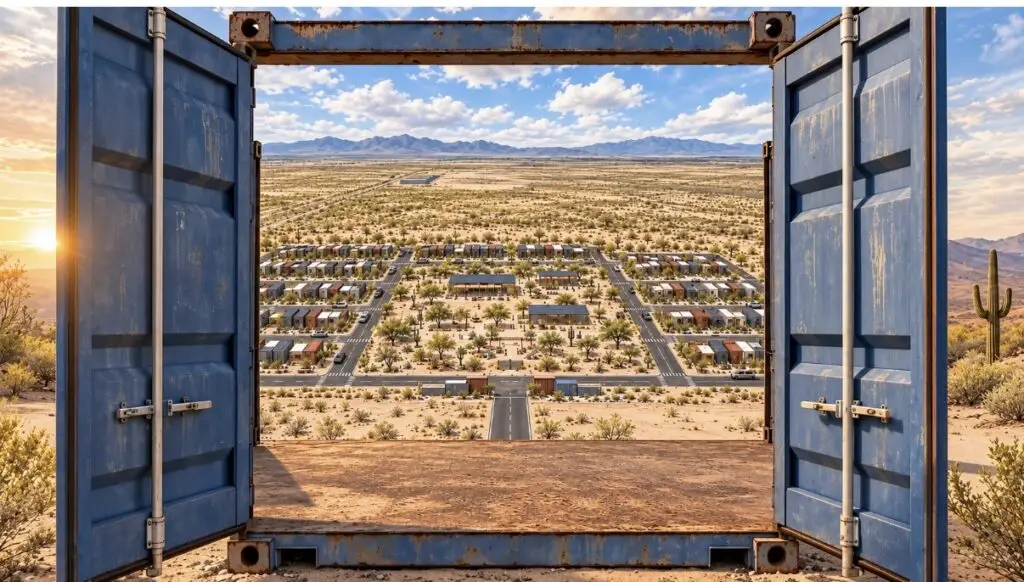
With more than 40,000 residents waiting for housing assistance, Tucson’s housing crisis demands creative thinking. Now, Boxes of Hope founder Beau Phillips has an unlikely solution: turn shipping containers from Arizona’s dismantled border wall into hundreds of comfortable rental homes, giving people priced out of the housing market a fresh start.
The ambitious plan is gaining ground. Boxes of Hope has partnered with La Frontera on a proposed village of 350 to 450 rental homes, identified a potential site, and begun planning. The organization hopes to sign a letter of intent with the landowner in January 2027 and has support from Tucson city officials, U.S. Sen. Mark Kelly’s office, and the Arizona Department of Housing.
“I founded Boxes of Hope to create a safety net against homelessness because too many people work hard every day and still can’t afford a place to call home,” says Phillips. “These containers once stood at the border to keep people out. Now, we’re turning them into homes that welcome people in. I can’t imagine a better purpose for four tons of steel.”
From Keeping People Out To Welcoming People Home
The idea took root when Phillips joined a protest against Arizona’s shipping-container border barrier. After its dismantling, he contacted the Arizona Department of Surplus and enlisted Tucson native Ryan Egan, a container-conversion expert, to help turn the idea into reality.
La Frontera CEO Dan Ranieri is co-leading the proposed village, which aims to give seniors, veterans, singles, and couples more than an affordable address. Plans include job training, behavioral health care, and Section 8 assistance to help residents find lasting stability.
The idea is already drawing attention. Thousands of University of Arizona homecoming fans recently previewed a model home developed by the university’s architecture students, showing how a steel container can become a comfortable living space.
Forget rows of rusty metal boxes. Boxes of Hope envisions a colorful village, with local artists painting murals that celebrate Tucson’s culture. There’s an environmental payoff, too: converting 400 containers would repurpose more than 3 million pounds of steel.
“Putting a roof overhead is just the beginning,” says Phillips. “We want residents to know their neighbors and feel proud of where they live. If we can make that happen in Tucson, imagine what we could do across the country.”
Boxes of Hope is seeking donations to create additional model homes and welcomes individuals, businesses, foundations, and partners ready to help bring the village to life. For Phillips, the real measure of success will be hundreds of people turning their own keys, closing their front doors, and finally having a place to call home.
Insider Takeaways
- From border barriers to affordable homes. Boxes of Hope plans to transform 350 to 450 shipping containers from Arizona’s dismantled border wall into a Tucson rental community, giving steel once used to divide people a remarkable second purpose.
- Small footprint, big possibilities. Each 40-foot container would become approximately 300 square feet of insulated, air-conditioned living space, complete with a private bedroom, queen bed, bathroom, kitchenette, storage, new flooring, windows, and sliding glass doors. Estimated conversion cost: $59,000 per home.
- More than four walls and a roof. Partnering with La Frontera, the proposed village would provide temporary shelter, health care, behavioral health services, and Section 8 assistance for people facing housing instability, including seniors and veterans.
- Building homes while building futures. Planned on-site training in construction trades would help residents develop marketable skills, pursue certifications, and find employment. The vision goes beyond housing to lasting independence.
- A new chapter could begin in 2027. Boxes of Hope aims to reveal the village’s name, location, and development plans in January 2027, with construction targeted for later that year. Converting 400 containers could also repurpose more than 3 million pounds of steel.
To learn more, watch the Boxes of Hope video, or support the project at boxesofhopeaz.org/donate.