
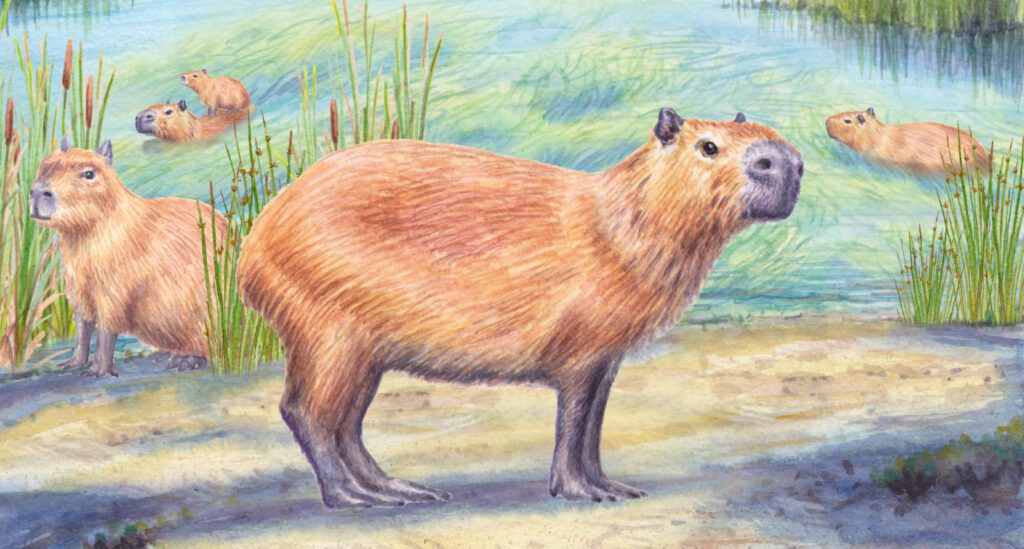
Leave it to a capybara to casually wreck a desert’s whole reputation.
University of Arizona researchers are part of a team studying a nearly 9-million-year-old fossilized capybara tooth found in northern Chile’s Atacama Desert, a place better known for extreme dryness than semiaquatic rodents.
That is what makes the discovery so strange.
Capybaras are tied to wetlands, rivers and persistent surface water. Today, they live east of the Andes, not in coastal Chile. So finding one in the Atacama is less “cute fossil moment” and more “wait, what was happening here?”
“Finding a capybara tooth in a marine deposit in what today is one of the driest regions on Earth is just freakish,” says Priscilla Martinez, the study’s lead author and a doctoral student in the University of Arizona Department of Geosciences.
The study, currently in press in Scientific Reports, challenges the long-standing idea that the Atacama has been continuously dry for roughly 40 million years.
And the tooth is not working alone.
Researchers also found evidence of freshwater fish, gavials and plant life including palms and other flowering species. Translation: ancient Atacama may have looked a lot less barren than anyone expected.
“Think sunny Southern California full of palm trees,” Martinez says. “You don’t really expect the Atacama Desert to have palms, and we’re not sure if they were blooming extensively there, but they were definitely there.”
As for how capybaras got there, researchers do not think they crossed the towering, arid Andes. Instead, they may have followed low-elevation wetland corridors around northern South America before making their way into what is now northern Chile.
The fossil was found at El Morro, part of the fossil-rich Bahía Inglesa Formation, an area already famous for dramatic prehistoric finds.
For U of A researchers, the bigger takeaway is about climate. Understanding how deserts shifted in the distant past can help scientists better understand how sensitive environments respond to changing conditions over time.
All from one tiny tooth with absolutely no business being there.
Insider Takeaways
- U of A researchers are part of a team studying a nearly 9-million-year-old capybara fossil from northern Chile.
- The find is the first and oldest known capybara record from coastal Chile. The discovery challenges the idea that the Atacama has been continuously dry for roughly 40 million years.
- Freshwater fish, gavials and palm evidence point to much wetter ancient conditions.
- Researchers believe capybaras may have followed wetland corridors around northern South America instead of crossing the Andes.
Click here to learn more.