In Scottsdale’s luxury home market, design trends move quickly. But Bogdan “Bobby” Banica, owner of Febal Casa Scottsdale, is not interested in rooms that perform for one season. He is focused on homes that still feel resolved years later.
At Febal Casa Scottsdale, Banica’s philosophy starts with a simple distinction: modern design is not the same as trendy design. Modern can be warm, livable and lasting when it is built on proportion, quality and intention.
“Timeless design comes down to three things: proportion, material quality and intention,” Banica says. “When cabinets are sized correctly to the architecture, when surfaces are honest about what they are, real wood, real stone, real lacquer, and when nothing is fighting for attention, a space holds up beautifully over decades.”
A showroom built like a home
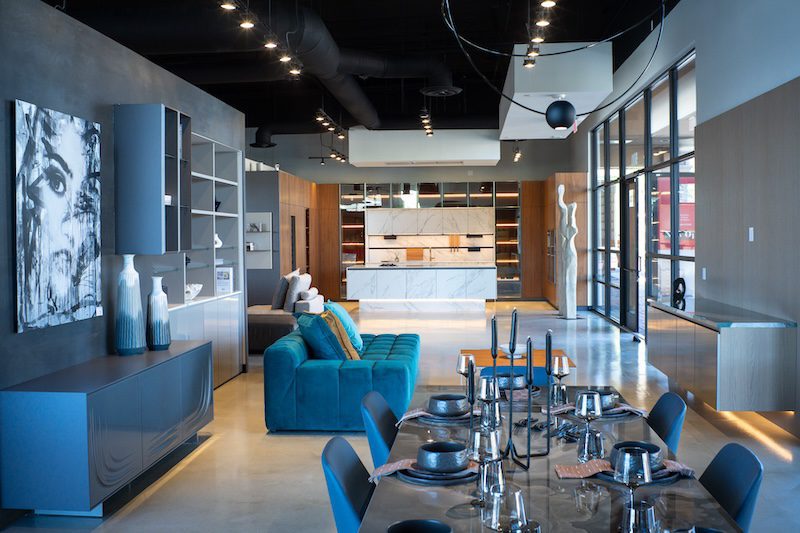
Located at 7550 E. Greenway Road, Suite 115, Febal Casa Scottsdale is designed less like a traditional showroom and more like a finished residence. Kitchens flow into living areas. Materials continue from one space to the next. Cabinetry, lighting, surfaces and architectural details are presented as part of one larger system.
For Banica, that full-home perspective is the point.
“We don’t look at a home as a bunch of separate pieces,” he says. “It’s about how everything works together.”
Febal Casa Scottsdale offers an integrated design-build solution through its in-house connection with Atelier 507, a licensed general contractor also led by Banica. Together, the two teams allow clients to move from cabinetry and furniture into remodels, additions, structural planning and installation without separating design from execution.
The client experience moves from discovery to delivery: lifestyle planning, showroom material selection, 3D renderings, Italian manufacturing coordination and final installation. This keeps the project cohesive from concept to completion.
Bobby Banica’s global lens
Banica’s perspective was shaped long before he arrived in Arizona.
Born in Romania, educated in Bucharest and trained in architecture and restoration design, he spent more than a decade leading residential, hospitality and commercial projects across Europe. His background includes work tied to brands such as Mercedes-Benz, Hilton Hotels and Bayer, experience that gave him a broad understanding of how people move through private, public and commercial spaces.
That global point of view matters in Scottsdale, where luxury homes must balance polish with ease. Interiors here need to work for desert light, entertaining, indoor-outdoor living and clients who expect refinement without stiffness.
Banica’s answer is not to make every home look European. It is to bring European discipline to the design process.
Modern, but not cold
In Scottsdale, Banica sees homeowners moving away from stark minimalism and dated traditional cabinetry. They want clean architecture, but not sterile rooms. They want warmth, but not clutter.
“What we see in Scottsdale, and in the homes we work in regularly across North Scottsdale, Arcadia and Paradise Valley, is a merging of the two,” he says. “Clients don’t want a cold showroom experience, and they don’t want traditional cabinetry that looks like it came out of 2005. They want warmth inside a clean structure.”
That balance often appears in matte finishes, natural wood accents, integrated handles, soft-close systems and warm neutral palettes. It shows up in stone with movement, open shelving that softens cabinetry and lighting that creates atmosphere.
For materials, Banica points to quartzite, marble, honed limestone, matte lacquers in warm whites and off-whites, and real wood veneers such as oak, walnut and Eucalipto. For color, he advises staying close to nature with warm whites, warm grays, greiges and earth tones.
What ages and what lasts
Banica is direct about design choices he believes will age poorly. Overly dark monochromatic kitchens are high on the list, especially when walls, cabinetry and countertops all carry the same near-black tone.
“It photographs beautifully on Instagram but tends to feel oppressive to live in, and it reads instantly as ‘2023,’” he says.
He is also cautious about distressed finishes made to look raw or unfinished, along with chevron and highly patterned tile used too aggressively. A restrained application can create rhythm. Overuse makes the trend dominate the home.
Febal Casa’s “total living” philosophy is built around the idea that a home should feel connected from room to room, including the visible spaces and the hidden ones. Concealed storage, integrated organizers, pantry zones and architectural lighting can determine whether a kitchen stays beautiful after the first week of use.
Banica also pushes back against the idea that Italian design must be inaccessible. Modular systems and adaptable configurations allow Febal Casa to tailor projects across different budgets while preserving the design intent.
“The Italian approach to cabinetry design, which is what Febal Casa brings to market, isn’t about fashion cycles,” Banica says. “It’s about system design, materials engineering and interior architecture.”
Timeless design, in his view, is not about resisting modern life. It is about refusing to make every room announce the year it was remodeled.
“When you buy right the first time, you’re not remodeling again in 10 years,” Banica says. “Invest in something you’ll still love when your life looks different than it does today.”