
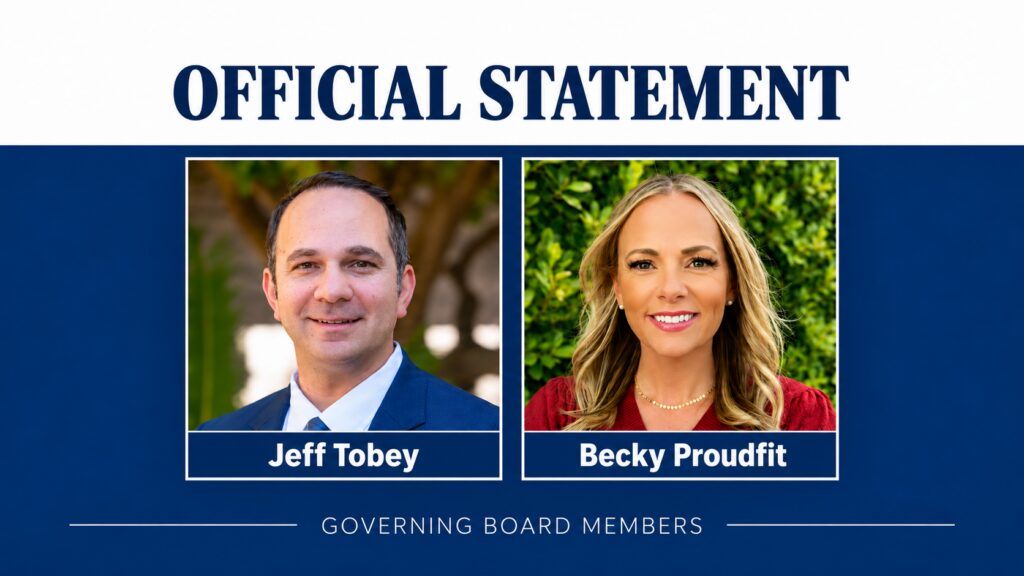
Following a heated Oct. 8 Peoria Unified Governing Board meeting, Board President Jeff Tobey and Board Clerk Becky Proudfit are speaking out, issuing a joint statement that puts transparency, accountability and public trust front and center.
The statement follows the board’s 3-2 vote to refer a possible Open Meeting Law violation to the Arizona Attorney General’s Office. At issue are concerns over the potential disclosure of confidential executive-session information, the public treatment of a constituent who requested records and unverified reports that Board Member Heather Rooks’ phone and computer may have been wiped following a public records request.
Tobey and Proudfit are calling for an independent review, the preservation of public records and accountability across the board. Their message is clear: Transparency isn’t just something elected officials talk about. It’s a responsibility that comes with the job.
Joint Statement from Peoria Unified Governing Board Members Jeff Tobey & Becky Proudfit
“On Oct. 8, the Peoria Unified Governing Board voted 3–2 to self-report a possible open meeting law violation to the Arizona Attorney General’s Office. The matter concerns the possible disclosure of confidential executive-session information. No board member was named in the motion.
Heather Rooks chose to identify herself. That was her decision. Being asked to answer serious questions is not intimidation, and an independent review is not retaliation. It is what happens when there are legitimate concerns that the law may not have been followed. Accountability is not an attack, and transparency cannot be something we demand of others but resist when the questions turn toward ourselves.
At the meeting, Ms. Rooks said she was distraught and upset that this accusation was dropped on her at the last minute and that she did not have the energy to continue the meeting. She had time, however, to sit for an interview with 12News shortly before the meeting on this matter. The public deserves consistency between what elected officials say in front of a camera and how they conduct themselves in the boardroom. Questions about potential violations of the law deserve a formal review, not a debate over who received the most favorable media coverage.
We are also troubled that one constituent was publicly identified and criticized by Rooks for requesting public records. Six people requested the same information. Only one was singled out. Every citizen has the right to request public records without fear of being publicly singled out by an elected official. That principle should apply regardless of who makes the request or whose conduct is being questioned.
Each member votes according to our own convictions, and we expect every board member to follow the law. We are past the point of governing through social media optics, carefully crafted narratives and competing headlines. Public service is not a public relations contest. It is a responsibility to uphold the law, protect the public trust and put the interests of students and families first.
There are also serious questions about the preservation of records, including reports that Ms. Rooks’s phone and computer were potentially wiped following a public records request asking the board for a search of our personal devices after Ms. Rooks’s 12News interview. Those reports have not been independently established, and any questions about the preservation of records deserve a proper factual review.
Confidential executive-session information should not be appearing in the public space. That is not transparency. Depending on the information involved, unauthorized disclosures can put student privacy and the integrity of sensitive proceedings at risk. Protecting children and preserving the integrity of the process must always take precedence over generating headlines.
Enough is enough. This is not about personalities, political theater or who controls the narrative. It is about the law, the responsibility that comes with holding public office and the standards every elected official swears to uphold.
The Attorney General’s Office is the appropriate authority to review the facts. We will cooperate fully, respect the process and let the evidence speak for itself.
And while we work to hold others accountable during a difficult chapter for this district, we must be equally willing to hold ourselves accountable. That standard does not change based on whose conduct is being questioned, whose name is in the headlines or whose political interests are at stake.
Accountability is not a talking point. It is an obligation. And it starts with us.”
To learn more about the Peoria Unified Governing Board, visit peoriaunified.org/page/governing-board.