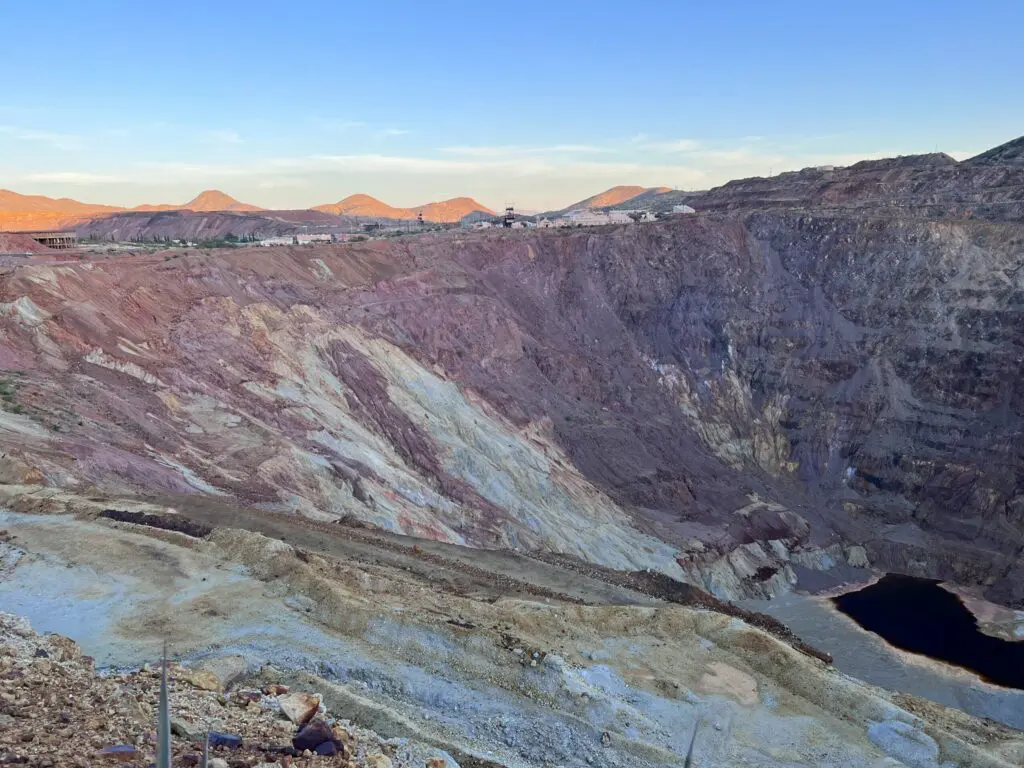
The Lavender Pit may sound poetic, but nothing prepares you for the scale of this enormous open-pit copper mine carved into the edge of Bisbee. Spanning roughly 300 acres and active from 1950 to 1974, the pit drops in dramatic terraced layers of rust, gold, and mineral green—an industrial canyon that’s strangely beautiful in spite of its grit.
The entire site is fenced off (as one would hope with a drop this severe), but the public overlook along AZ-80 gives visitors an unobstructed view straight into the heart of Bisbee’s mining past. Walk the perimeter and you’ll spot small peepholes in the fence—perfect for framing the depths of the crater. Yes, leaning into them looks ridiculous. Yes, everyone does it. And yes, the view is always worth it.
The scale is hard to grasp until you’re standing above it, watching the colors shift with the light and realizing just how much earth was moved to create this place. It’s one of those stops you visit expecting “a big hole” and leave genuinely impressed by the spectacle of it.
For geology fans, history lovers, or just curious road-trippers, the Lavender Pit remains one of Bisbee’s most iconic—and unexpectedly mesmerizing—views.
Insider Takeaways
-
The Lavender Pit is a sprawling 300-acre open-pit copper mine that operated from 1950 to 1974, its vast scale offering a dramatic glimpse into Bisbee’s industrial past.
-
A free public overlook along AZ-80 gives visitors a wide, unobstructed view straight into the terraced heart of the Lavender Pit.
-
Small peepholes tucked into the fence line offer surprisingly cinematic photo angles of the pit’s depth and color—an unexpectedly fun way to experience the site.
-
The Lavender Pit has become one of Bisbee’s essential stops, the kind of roadside detour that first-timers inevitably end up talking about long after they’ve left town.
-
It’s an oddly beautiful mix of geology, desert color, and mining history—proof that the Lavender Pit is far more mesmerizing than its name lets on.
For more information, visit Discover Bisbee.