Arizona wants to train America’s next generation of astronauts, and it has a plan to get students into class before the permanent campus even exists.
On November 16, the state submitted its application to host the proposed U.S. Space Academy, a new federal institution intended to train astronauts, engineers and technicians.
The plan would launch at Arizona State University’s Novus Innovation Corridor in Tempe, with an inaugural class of 300 students targeted for 2028. That would allow students to begin training while the state develops a permanent campus in either Mesa or Flagstaff.
Mesa’s proposed site sits within ASU’s Polytechnic Innovation Zone near Phoenix-Mesa Gateway Airport, surrounded by the region’s growing aerospace and manufacturing industries.
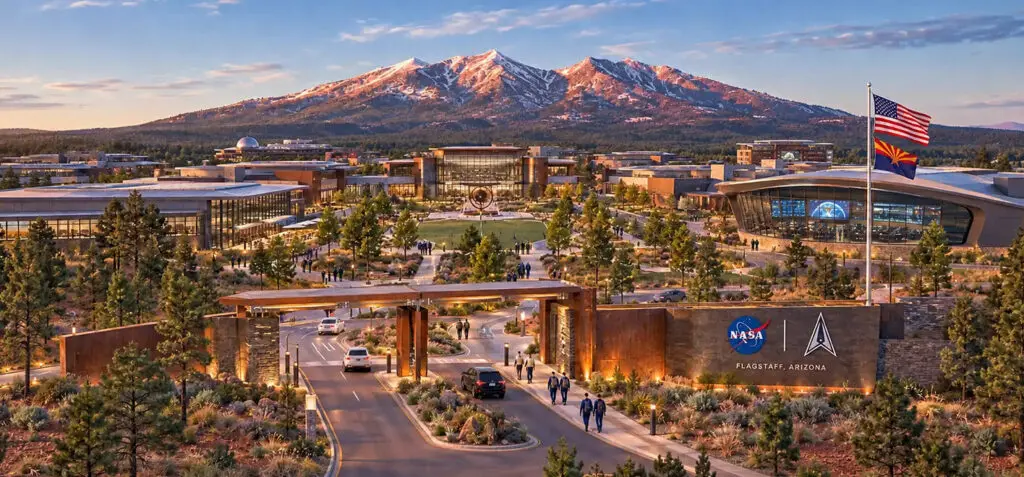
Flagstaff’s alternative is near Pulliam Airport, Northern Arizona University, Lowell Observatory and the U.S. Naval Observatory Flagstaff Station.
Either permanent location could be ready by 2031.
And Arizona isn’t exactly starting from scratch. According to the governor’s office, the state ranks fourth nationally in NASA funding despite not having a NASA center. Arizona is also home to more than 1,200 aerospace companies supporting over 65,000 jobs and generating approximately $30.6 billion in economic impact.
The proposed academy could eventually accommodate as many as 4,000 students, creating a potential pipeline of astronauts, engineers and technicians while bringing additional investment and national attention to Arizona’s aerospace industry.
But there’s a catch: Arizona hasn’t won anything yet.
Maryland, Louisiana, Colorado and Texas are among the states pursuing competing proposals. The federal government has not selected a host, and the academy’s final structure, location and funding remain subject to federal decisions.
A presidential commission is expected to deliver recommendations by the end of 2026.
For now, Arizona isn’t just offering NASA a plot of land. It’s offering a launchpad: start teaching in Tempe, build for the long haul in Mesa or Flagstaff, and tap into a workforce already looking skyward.
Whether Washington buys the pitch is the next big question.
Insider Takeaways
- Three-city strategy: Tempe would host the initial program, while Mesa and Flagstaff are proposed as permanent campus locations.
- 2028 launch: Arizona is proposing an inaugural class of approximately 300 students.
- 2031 target: The permanent campus could be ready by 2031.
- Big ambitions: The academy could eventually accommodate as many as 4,000 students.
- Aerospace powerhouse: Arizona reports more than 1,200 aerospace companies, 65,000 jobs and $30.6 billion in economic impact.
- Not a done deal: Arizona faces competing proposals from other states, with federal recommendations expected by the end of 2026.
THE BOTTOM LINE
Arizona isn’t just offering NASA a plot of land. It’s offering a launchpad: start teaching in Tempe, build for the long haul in Mesa or Flagstaff, and tap a workforce already looking skyward. Whether Washington buys the pitch is the next big question.